
APA 2025
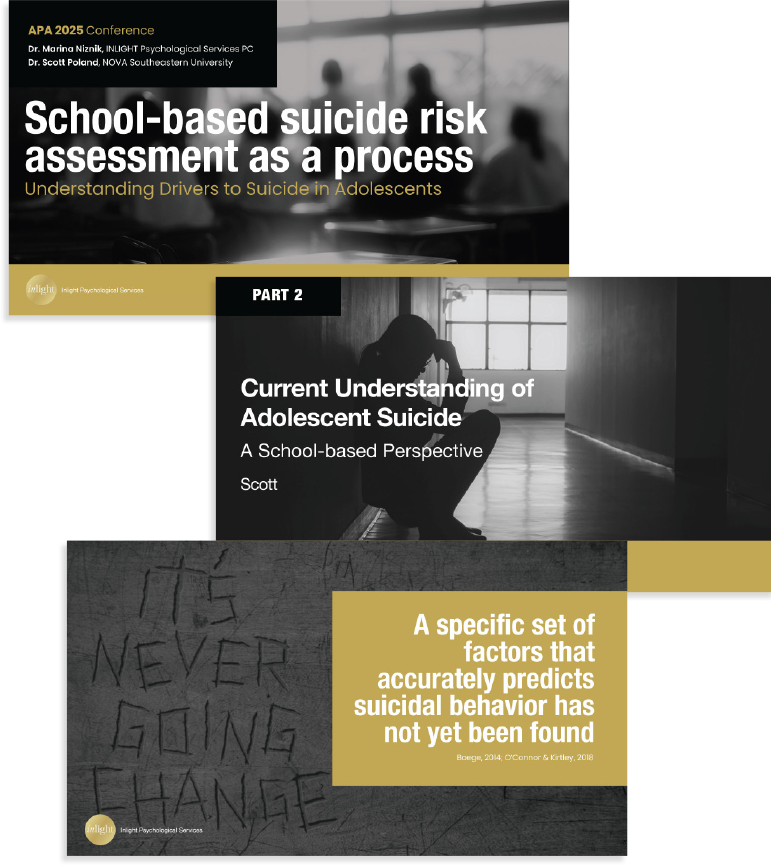
School-based suicide risk assessment as a process: Understanding drivers to suicide in adolescents
Adolescent mental health issues are on the rise (CDC, 2023; World Health Organization, 2021). Gen Z adolescents are “the most likely of all generations to report poor mental health” (APA, 2018), and among youth, suicide is now the second leading cause of death (CDC, 2023).
Assessing suicidal thoughts and behaviors is integral to prevention, and school mental health professionals are well positioned to do so (Law et al., 2015). While there is no singular approach, research supports managing school-based risk assessments as an ongoing process rather than a one-time event.
Within the past year, 22% of high school students seriously considered suicide and 10% made an attempt (CDC, 2023), suggesting that school mental health professionals could justifiably be conducting risk assessments for one-quarter of the student population. Elevated rates are evident among female, LGBTQ+, Black, and Hispanic adolescents.
The heterogeneity of suicidality in adolescents necessitates an exploration of contextual and individual factors to understand drivers—defined as thoughts, feelings, and behaviors that lead to an individual becoming suicidal (Tucker et al., 2015). Identifying variables that disproportionately affect individuals can mitigate risk (O’Connor et al., 2014; Runkle et al., 2023) and is a cornerstone of culturally competent risk assessment (The Jed Foundation, 2023; CDC, 2023). Structured tools better identify suicide risk than clinical interviews alone (Posner, 2011).
This session focuses on suicide assessment as a process. Evidence-based measures are presented within a broader contextual framework to improve identification of drivers of suicide in adolescents.
“Definitional issues aside, suicidal crises can escalate rapidly in youths and attempts can occur with minimal planning. The field’s ability to assess and predict the likelihood of such rapid escalation is poor, a fact that highlights the importance of taking appropriate planning and prevention steps with youths at all levels of risk” (Pettit et al., 2018, p. 3).
Learning objectives
Introduce evidence-based measures for assessing suicide risk in adolescents in schools.
Build familiarity with the conceptual framework of drivers of suicide and the importance of ongoing assessment in adolescents.
Reference list
American Psychological Association. (2018). Stress in America: Generation Z.https://www.apa.org/news/press/releases/stress/2018/stress-gen-z.pdf
Centers for Disease Control and Prevention. (2023). Youth Risk Behavior Survey: Data summary and trends report 2011–2021. https://www.cdc.gov/healthyyouth/data/yrbs/pdf/YRBS_Data-Summary-Trends_Report2023_508.pdf
Law, M. K., Furr, R. M., Arnold, E. M., Mneimne, M., Jaquett, C., & Fleeson, W. (2015). Does assessing suicidality frequently and repeatedly cause harm? A randomized controlled study. Psychological Assessment, 27(4), 1171–1181. https://psycnet.apa.org/doiLanding?doi=10.1037%2Fpas0000118
O’Connor, S. S., Brausch, A., Ridge, A. A., & Jobes, D. A. (2014). Applying the collaborative assessment and management of suicidality (CAMS) to suicidal adolescents. International Journal of Behavioral Consultation and Therapy, 5(3), 53–58.
Pettit, J. W., Buitron, V., & Green, K. L. (2018). Assessment and management of suicide risk in children and adolescents. Cognitive and Behavioral Practice, 25(4), 460–472. https://www.sciencedirect.com/science/article/abs/pii/S1077722918300440?via%3Dihub
Posner, K., Brown, G. K., Stanley, B., Brent, D. A., Yershov, K. V., Oquendo, M. A., Currier, G. W., Melvin, G. A., Greenhill, L., Shen, S., & Mann, J. J. (2011). The Columbia–Suicide Severity Rating Scale: Initial validity and internal consistency findings from three multisite studies with adolescents and adults. American Journal of Psychiatry, 168(12), 1266–1277. https://doi.org/10.1176/appi.ajp.2011.10111704
Runkle, J. R., Harden, S., Hart, L., Moreno, C., Michael, K., & Sugg, M. M. (2023). Socioenvironmental drivers of adolescent suicide in the United States: A scoping review. Journal of Rural Mental Health, 47(2), 65–80.
The Jed Foundation. (2023). Youth suicide: Current trends and the path to prevention. https://jedfoundation.org
Tucker, R., Crowley, K., Davidson, C., & Gutierrez, P. (2015). Risk factors, warning signs, and drivers of suicide: What are they, how do they differ, and why does it matter? Suicide & Life-Threatening Behavior, 45(5), 679–688. https://doi.org/10.1111/sltb.12161
World Health Organization. (2021). Mental health of adolescents. https://www.who.int/news-room/fact-sheets/detail/adolescent-mental-health